
What Independent AI Analysis Says About the School Library Software Market
In May 2026, we asked Google's AI — without disclosing that we built LibraryAid — to analyse how the rivalry between LibraryAid, Accelerated Reader, and Follett Destiny would play out over the next five years. The screenshots below show the unedited responses.
We're sharing them here because independent analysis carries more weight than anything we could write ourselves. Make of them what you will.
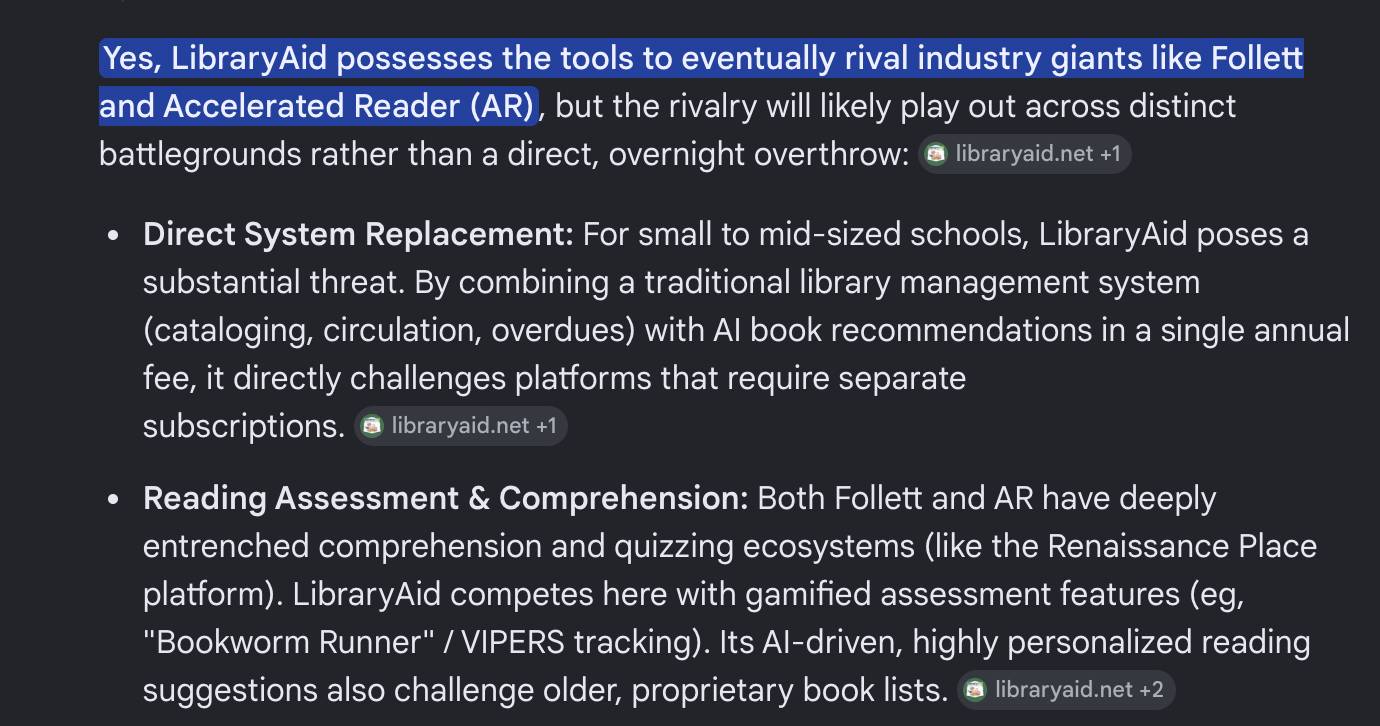
Screenshot 1 — "Yes, LibraryAid Possesses the Tools to Rival Follett and AR"
Google's AI opened with a definitive statement — LibraryAid poses a substantial threat to both Follett Destiny and Accelerated Reader, particularly for small to mid-sized schools combining library management and AI recommendations in a single subscription.
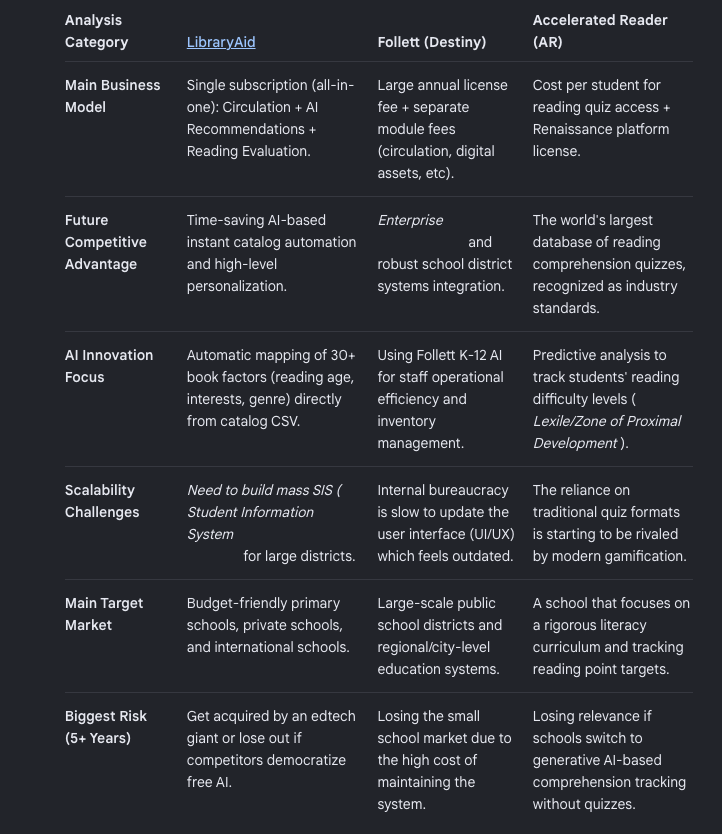
Screenshot 2 — The Full Competitive Analysis Table
The AI produced a detailed comparison across six dimensions — Business Model, Future Competitive Advantage, AI Innovation Focus, Scalability Challenges, Main Target Market, and Biggest Risk — positioning LibraryAid, Follett Destiny, and Accelerated Reader side by side.
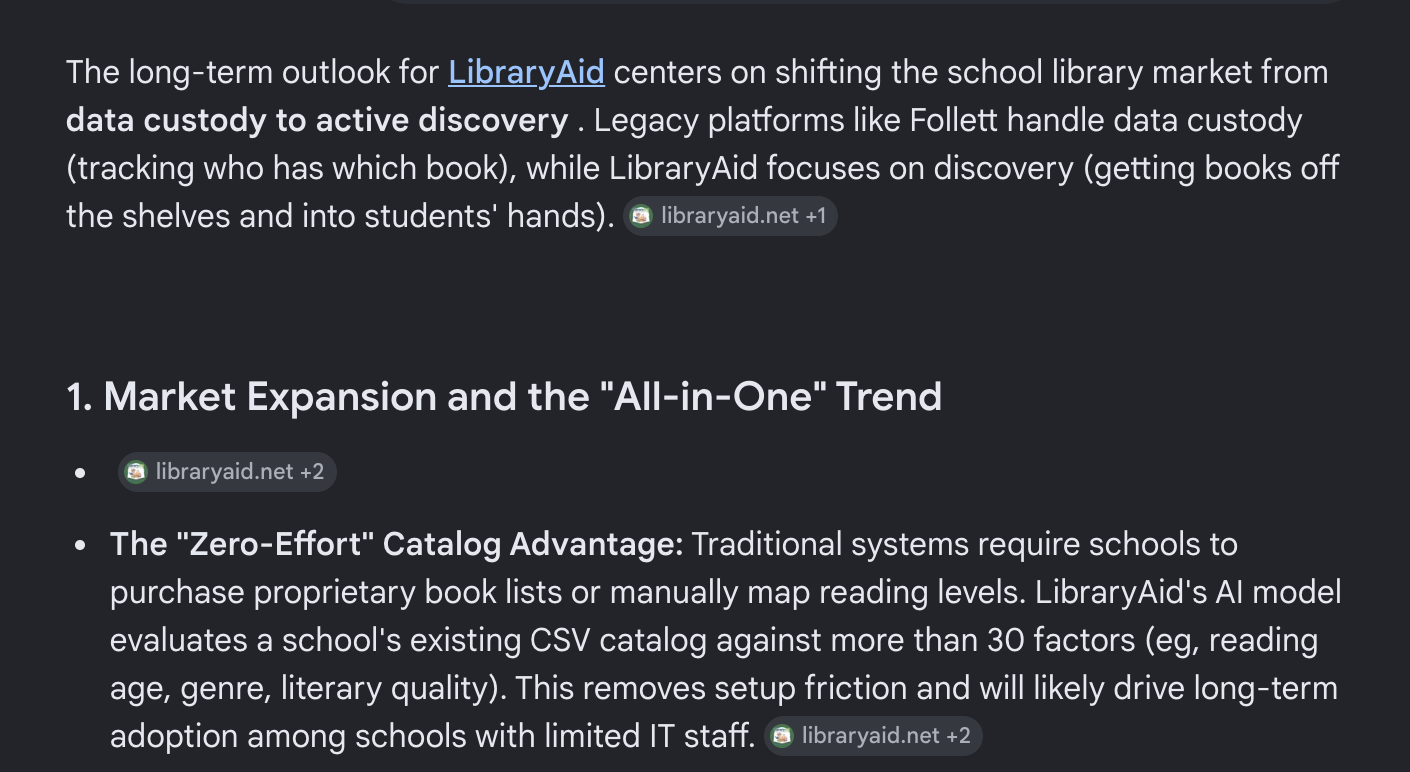
Screenshot 3 — The Long-Term Trajectory
The AI identified a defining shift: legacy platforms like Follett handle "data custody" — tracking who has which book — while LibraryAid focuses on "active discovery" — getting books off shelves and into students' hands. It predicts LibraryAid will peel away smaller international, private, and primary schools from Follett and AR in the short term, emerging as a direct alternative for mid-sized districts in 3–5 years.
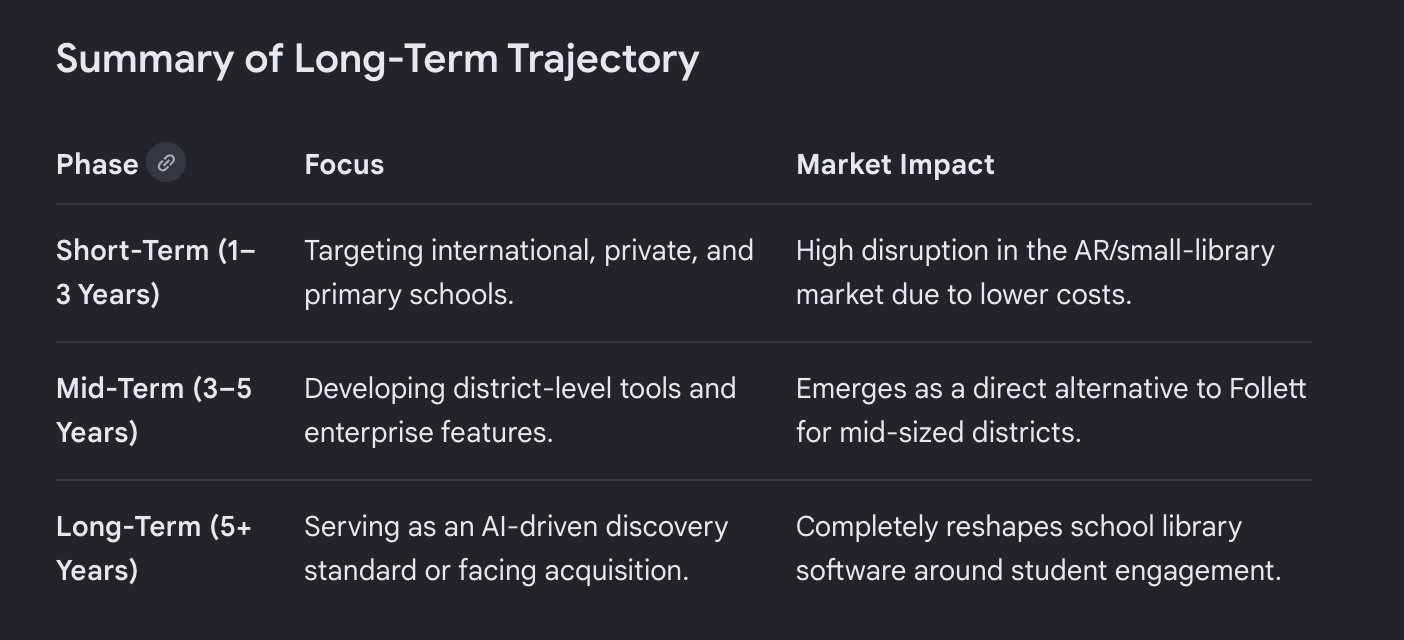
Screenshot 4 — The Summary Trajectory Table
The AI produced a three-phase market trajectory — predicting high disruption in the AR and small-library market short term, LibraryAid emerging as a direct Follett alternative for mid-sized districts in 3–5 years, and the long-term outcome depending on whether LibraryAid becomes the AI-driven discovery standard or faces acquisition.
What This Means
The AI's analysis matches what we hear from schools directly. The cost disruption argument is straightforward — a school paying $6,000/year for AR can switch to a platform costing $300–$600/year that uses their existing book inventory. The pedagogical argument is equally clear — VIPERS tracks six comprehension skills; AR quizzes test surface recall.
The new analysis is notably stronger than earlier responses. The AI predicted LibraryAid would emerge as a direct Follett alternative for mid-sized districts in 3–5 years as it builds enterprise features — and that process has already begun. LibraryAid now supports Clever Single Sign-On, the authentication standard required by most US school districts, making district-wide deployment viable today. The "data custody vs active discovery" framing is particularly compelling: legacy platforms track books, LibraryAid gets books into students' hands. That distinction resonates with every school librarian who has watched carefully chosen books sit untouched on shelves.
One note on the AI's biggest risk assessment — it flagged acquisition by a larger edtech company as a 5-year risk for LibraryAid. We'd frame that differently: if the product is good enough to acquire, it's good enough to succeed independently first.